"Go and see what lies in the terrace at the back" exclaimed Wife, as soon as I returned home from the office late one winter Tuesday evening. In our narrow backyard I espied in the dim light of a distant bulb a large dark triangular form lying still on the ground. On closer inspection it turned out to be a large bird, an enormous kite, locally known as "chil " (Milvus migrans). My heart sank at the sorry sight of the bird. It was obviously sick or injured or both. It had collapsed with its legs under it, so that its chest was on the cold cement floor. Even its head was lying on the floor, turned to one side, as if resting on a pillow. The wings drooped to the ground. Its eyes remained closed even as we talked. Birds or animals which once collapse like this usually never recover.
Memory harked back to my youthful days, to the first kite I tried to save. I was then about 10 years old. While playing with the neighbourhood gang a simple and energetic game of 'Kings' with a worn out tennis ball in the ground of the unnamed mosque, I was interupted by a friend, who had come running.
"Come quick," he panted "a chil is drowning in Kumeer 's pond".
Kumeer (=Crocodile) was the local milkman, who maintained an illegal cowshed behind the girls' school. Why he was nicknamed Crocodile I do not remember, for his girth and gait resembled a healthy hippopotamus which has recently swallowed an adult elephant. One of the whims of childhood I imagine. The run off from Kumeer's cowshed created and maintained the pond, which was so filthy, that even Crocodile was said to refrain from adulterating the milk with the pond water. None of my friends dared to wade into the pond to pick up the kite, which was still struggling in the water, for no one but me was such a fanatic as to risk the inevitable sound thrashing at home, if his mother found out that he has stepped into Crocodile's pond. We all knew that even walls and buildings were as transparent as the thin air to all mothers' eyes. So down I went into knee-deep mud and recovered the kite, while others formed a chain, the end person of which held on to my belt, to prevent me from joining the kite in totality. Friends then washed the kite and my legs with clean water supplied by the cowherds in the employ of Crocodile. I dried the kite and in the falling light of the dusk placed it in the lowest fork of a nearby tree. Next morning I ran to see the kite and found it floating in the pond face down, dead and cold. Probably it tried to fly away. Since I made the mistake of placing it in the tree facing the pond, it probably just popped out and fell in the water. A small mistake and a life gone. Since cremation turned out to be impracticable, we buried it in the field of the unnamed mosque, consoled each other and prayed that it lives better in the nether life.
I held little hope for this new kite. Since our narrow terrace was surrounded by tall buildings on all sides, it is extremely difficult for large birds like kites to intentionally fly down. So I guessed that this kite must have fallen down from the parapet at the roof, two stories above. Still, one tries what one can. Most birds have normal body temperature of over 40°C, while the cement floor was not more than 20°C and surely would get colder in the night. Since a wild creature would get nervous indoors, I placed a few newspapers on the terrace floor, placed the kite on them and covered it up by several more sheets. The kite was very light in weight for its size. Probably it could not get any food for the last few days. It barely moved while I handled it, a most unusual behaviour of a wild creature. Still less hope of survival, it seemed. By the time I showered and came out of the bathroom, it had thrown away the covering sheets of newspapers, but was otherwise lying in the same position. I debated mentally how to keep it for the night. Lying like that outdoors could be dangerous. Our boundary wall was the main thoroughfare of all the alley cats in the neighbourhood, while roaming from houses by the front street to those at the back. When I kept pegions as pets, quite a few were eaten up by the cats. How much a dying but large, live kite would appeal to their appetite was a serious question. We dared not keep it in the bathroom, for Mother was afraid that it might fall head first into the toilet bowl, as it happened with a baby sparrow in the past. Rather unlikely, considering the difference in size, I thought, but just in case. Inside the rooms it might move around and get underfoot. Ultimately, we let it lie in the terrace on a bed of newspapers, which in the morning seemed to have revived it.
In the light of the morning I picked the bird up and placed it on the wall of the water tank, while I examined it thoroughly. From its enormous size, deep chocolate colour and general appearance it was clear that 'it' was actually 'he'. In fact from the arrogance of his regal bearing it seemed that it was His Royal Highness The Chil. He was well armed with a set of formidable looking claws, powerful hooked beak and hooded hunter's eyes. On scrutiny he was found to bear deep but dried injury at the elbow of one wing. We cleared the clotted blood, poured 5% mercurochrome solution on the wounds and preened his feathers as well as we could. In daylight he did not look so sick as in the night before. Most of his feathers were quite slick. Still he was too weak to protest my handling. Inspection of the newspapers showed that whatever he had in his stomach produced very little output throughout the night. It could not be guessed from his droppings, if anything else was wrong. Trying to feed him created the most seroius problem. He refused all the six obvious foodstuff for a carnivore, which we offered him in succession : fish, meat and eggs once cooked, once raw. Desparing, Wife made a thick solution of milk powder and with an ink dropper slowly dripped it into his beaks. Half trickled down his chest, half he swallowed. Wife also made him swallow a penicilin tablet. By bodyweight proportion with respect to a human, we calculated that this would be enough for him for 24 hours. After feeding time I cleaned him with a wet rag, dried and fluffed his chest feathers. Both of us left for our respective places of work, leaving Chil sunning and preening himself in the terrace, care of Mother.
Returning in the evening I found Chil in his original posture, lying down again with his chest, head and wings to the floor.
"What happened ?" I asked in alarm, for he was looking so perked up in the morning.
"Look at his theatrics !" said Wife, "Only a moment ago he was standing upright. He must be doing this craving your sympathy, now that he has found you are home."
I picked him up and he reclined in my hands like a babe in arms. Wife had already fed him milk, wondering how long he would last on such a fare. Mother reported that he spent the day trying to sit on some sort of a perch. He did not like to perch on the water pipeline. The things of his preferance were our flower pots, many of which he had overturned, while trying to sit on them and broken some. We tried some more variety of food. As it turned out to the astonishment of all, the only food he ultimately accepted was highly spiced potato curry.
The table manners of Chil left a lot to be desired. He would take a piece of potato in his beak and transfer it to his claws. He would then look up and only after reassuring himself that a waiter or waitress was still at close attendance, daintily scoop out a portion of the potato with his hooked beak, in spite of his weak health shake his head vigorously, thereby disintegrating the potato to smithereens, with bits and pieces sprinkled liberally on the walls and our clothes, rear up with great pomp and show, hold his head high and swallow the microscopic morsel that remained in his mouth. Like an aristrocat, Chil accepted food only after it had been repeatedly requested of him. In fact he carried out his feeding manners to such an extreme, insisting on eating only from our fingers, that had it not been for his size, colour and lack of baby skin around his beak, I would have thought that this is an immature and unfledged bird.
After accepting about a quarter kilo of potato curry, of which he ate a tenth and distributed the rest, Chil felt much better. He then started parading around, found that the terrace was too dark and hence decided to enter the bathroom and guard Wife against ghosts and goblins while she took her bath. He stood guard precariously balanced at the rim of an empty plastic washtub, so Wife had an exhilerating bath wondering when he will fall down into the bathwater, or become nervous and suddenly spread his wings in the narrow confines of the bathroom. In keeping with his regal solemnity, His Royal Highness did none of these, but being annoyed when the bathroom lights were switched off, he walked out in a huff and sat in the terrace. However, he deigned to accept a few sheets of newspaper for the night.
Strangest of all, during his entire stay at our house, not a single cat dared walk by. Even the pesky crows avoided our house like plague, even when raw fish or meat was being dressed by the maidservant sitting outdoors in the terrace, an otherwise unthinkable situation.
Next morning was a repeatation of the previous day's experience of feeding and cleaning him. Chil turned out to be rather ungrateful towards women, especially Wife, who took the trouble of feeding him. He would rear up, erect the feathers on his head and neck, threateningly open his beaks whenever she came close. He spent his day sunning himself, breaking a few more flower pots and drinking deeply from the gutter, adamantly refusing to touch the pot of clean water left for him.
That was the day when I went around the town looking for alternative accommodation for Chil and it turned out to be an eye opener for me. We Indians pride ourselves for being compassionate to gods' creatures : "Who serves living beings serves the Supreme Being" and so forth. Once upon a time, a dove, hotly pursued by a falcon sought protection of King Shibi. When the falcon came and argued that nature had ordained that birds like doves are his prey and food and that it was also a king's duty to protect the falcon, King Shibi cut off and offered the hungry falcon an equal weight of his own flesh in lieu of the dove. Both the birds were of course gods in disguise, who reverted to their normal images, blessed the King, explained that they had come to test him and teach the population lessons in compassion. What a pity that the population has not learnt the lesson.
Our office was still connected through a crossbar telephone exchange, one of those failed technologies, which our politicians buy from other countries, going in foreign junkets and fattening their secret Swiss accounts in the process. I told the tale of the Chil to our harrassed telephone operator and told her to get me the phone numbers of all possible people, who might be persuaded to accept, house, feed and nurse a sick kite. Step number one was obviously the Calcutta Zoo. The gentle(?)man at the other end of the line was a bureaucrat.
"Hallo ! Calcutta Zoo ?" I enquired.
"Yes, Clacutta Zoo. What do you want ?" challenged a rude voice.
"Could you please tell me what to feed an injured kite that has fallen in our house ?"
"Kite !" he scolded, probably shocked at my audacity, "We don't want Kites." He banged down the telephone. Absolutely typically bureaucratic -- boorish, no replies relevant to the question and good for nothing but collecting salaries. Mr Zoo was not like King Shibi.
Going through the telephone directory, I came across the World Widlife Fund. That's it, I thought happily. Ms Telepone Operator could not get the connection, but WWF office was just a few buildings away. So I walked over and enquired. WWF office turned out to be full of a large number of beautiful pictures of cuddly animals and a small number of young and enthusiastic employees. No, they advised me after a sympathetic hearing, the function of this WWF office did not cover looking after kites, whether healthy or ailing, but I might try an animal lovers' society, which had an establishment in a street a kilometre away, exact address unknown.
I skipped lunch and went to that street, walked up and down the long road three times and just by chance discovered the destination. Crossing a long, dark, gloomy passage, I reached a hall of sorts, which could do well with some paint and illumination. There sat a brace of sombre old men, surrounded by the smell of disinfectants. I repeated my tale. No, they could not accept Chil, they only cared for cats and dogs, that too if absolutely unavoidable. From the desultry dialogue, I imagined they would not even care for a unicorn. Nevertheless, they said that I was making a mess of caring for the kite : I must feed him crushed mice, including the fur for good bowel movement, or else he will die of constipation. The last statement is the only pronoucement they made gleefully, although looking at me sternly. Hungry and hot from walking around in the midday sun, I walked out, wishing that they be born again as kites and drown in Crocodile's pond in their next life. The gods avenge sick kites after all, I discovered some months later. It seemed that this Society had some sort of British patronage. Someone visited from UK to check on their performance and having discovered that they spent more money on the member homo sapiens than on healing sick animals, cancelled their affiliation.
Back to the sympathetic boys and girls of WWF. This nice gang had meanwhile talked the matter over amongst themselves and discovered that one of the girls knew a man who kept a kite as a pet. What an angel of a man, I marvelled. They gave me his telephone number, with which I triumphantly came back to my office, as WWF phones were all out of order. Mr Kiteman's telephone was connected to the most overloaded exchange in the city. Miraculouly, after only eleven attempts I got through to him.
"I understand, that you have a kite and I wonder if ........." I started to say.
"Yes ! Yes ! Of course you can have him. Come over to my place and have tea with us. Then you can take him. Or, if you like, I can deliver the kite to you. Just tell me where you live" replied a voice, almost hysterical with anticipation.
"Actually, I do not want a kite." I could barely get in a few words edgewise, "An injured kite has fallen in our house. I was wondering if you will take him...."
"What ! What ! What ?" screamed Mr Kiteman in such terror, that I lost my nerve.
"Ahem. Hallo ! Hallo ! There is a noise due to bad phone connection. Can you hear me well ? What I was saying was, can you tell me what to feed him and what special care to take of him ? I have given him a penicilin tablet and put mercurochrome on his wounds, which seem to be healing anyway."
"You have to feed him what he wants. He will not eat what you want. I do not know if penicilin and mercurochrome will do him any good, or any harm for that matter. If you are worried, then you can take him to the Veterinary Hospital at Belgachhia, although I don't know how. Public buses and trams will not take him. I doubt if even taxis will agree. Kites look ferocious you know."
Where art thou now, O King Shibi - I thought.
"Didn't your kite ever fall sick ?" I asked.
"Never. This kite of mine lives in a cage from youth, when I got him, but has the worst possible temper. Ever since he is fully grown, I have often left his cage door open and let him free. But he just walks around the roof and returns to the cage at feeding time and at night. Yesterday he fought with the mongoose in the next cage. The mongoose has got a deep gash on its head and the tip of the kite's upper beak has broken off. He won't fly away ......." Mr Kiteman almost wept in the phone.
I let the phone down at the first polite opportunity. Mr Kiteman has committed the gross blunder of taming a wild creature and now hoped that it could return to nature and fend for itself. A baby is pretty in the mother's lap, the wildlife in the woods -- runs a proverb. From childhood, I was allowed to keep only pegions, which can be let free. Caged or fettered birds were not allowed. "How would you like to be left caged or chained yourself ?" asked Father, "Don't you think birds feel likewise ?" When I left home for college, there were no dearth of takers for my pegions. A kite is another story.
Next day we repeated our attempts to feed Chil different cuts of fish and flesh, we tried pieces of meat disguised in the potato curry -- no hope. Chil must be a member of the large local kite population, whose most popular sport is to swoop down and snatch packets of delicacies from absentminded hands of people, who have just come out of the nearest sweetmeat shop. Kites are really omnivorous. So we bought a piece each of all the differnet kinds of savouries from the corner shop and offered him -- no hope. We offered him the lush fare of winter fruits and vegetables : apples, beans, cabbages, cauliflowers, right upto yoghourt and zucchini, although not in alphabetical order as listed here -- no hope. The books on ornithology write about what kites eat, but not how to make him understand what he should eat. The books about pet birds do not mention kites. Mother and Wife were becoming frantic, I was also worried. We did not want Chil to die in our care, eating penicilin and potato curry, drinking milk and gutter water. The subject was discussed at length in my office, in the college where Wife taught, amongst our relatives and neighbours. No one knew how to feed Chil correctly.
"Today afternoon please go to your cousin, the Professor of Chemistry in the University." I suggested Wife. "Ask him to consult his collegues in the Zoology department, if they can suggest how to feed Chil his proper food. Also ask him if anyone knows the address of the renowned ornithologist Dr Salim Ali; not that I expect, that Chil will last till the time we write him a letter and get back the reply. If I have time tomorrow, after office I shall go to the birds bazar in the New Market and ask the shopkeepers, although I have never seen a kite being sold."
The Professor was out of station. Contrary to all our apprehensions, Chil's condition improved by the hour. Next day, when the midday sun was hot, he walked indoors, entered the first bedroom, inspected at length the undersides of the beds and the tables, rotating his head to all possible angles, such that not a single perspective was missed, even peeped behind the clotheshorse, but discovered nothing of interest. The floor was too highly polished for his clawed steps, so he paraded out pompously to the cool bathroom and composed himself for a siesta. He also practised shaking and moving his wings, a thing he was not doing at all in the past. He probably understoond that there was no space for spreading his enormous wings in full for a thorough testing.
I had outstation visitors and was very busy in the office. Two hours after office closing time, when I had just decided to call it a day, it struck me that I have not tried the Society for Prevention of Cruelty to Animals. I made a note in my desk calender to ring them up next day, during working hours. It was too late to go to the birds bazar in the New Market. I thought over the situation while riding home in the Metro Rail. Chil was too weak to spread his wings and hop up to the boundary wall, from which he could possibly have launched himself into a flight. The coming weekend I could take him out for a trial flight. I would take him to the neighbouring empty ground, place him on my arm and see if he could spread his wings. Then I would see what he does, if placed on the wall.
Reaching home I found it an abode of gloom. Mother and Wife were sitting in abject misery. That afternoon, while the maidservant was sweeping the terrace, she saw Chil suddenly spreading his wings, jumping up on the boundary wall and taking off in apparantly painless flight. This should have brought us immense relief and happiness, but sorrow and a feeling of loss was what actually prevailed.
That would have been the end of the tale, but for a singular incident next Tuesday. Mother had come out on the terrace to pick up the drying wash, when she suddenly saw an enormous kite. For a long time he just stood there, looking hither and thither, but accepted no food. Then unseen sometime he flew away for ever. Mother thinks it was Chil, who came to express his gratitude, but accepted no food for fear of been fed penicilin again. I don't think birds have brains enough for gratitude, but then why would a kite undertake a difficult and dangerous aerial manouvre in the narrow space between tall buildings for nothing ?

End
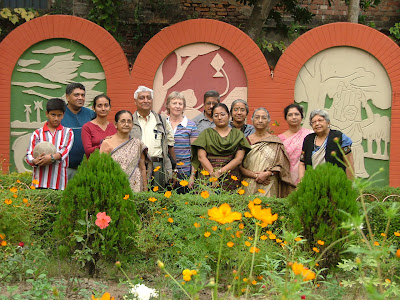
 Destination : At 22.59ºN, 88.92ºE Taki is the erstwhile capital city of an old and defunct Kingdom of Taki. It is presently a municipality under Hasnabad police station, Basirhat subdivision in North 24 Parganas district in West Bengal, India. It is separated from Bangladesh by the River Ichhamati.
 The journeys : This was one of those rare trips, where from the beginning the journey started pleasantly. We assembled at Mejomashi’s house at Salt Lake or Bidhannagar. Bimal was hired with his 20 seater (for school children) bus for the 12½ of us. So, it was quite spacious. We took off at about 10:15, travelling southward along the E M Bypass, passed Science City turned left to take the road to Bantala, Basanti etc. just by the P C Chandra Park, along road no. 3 (see map). As it turned out, the road was narrow, but unusually good for a Bengal village road. It was decidedly far better than the congested & pot-holed road no. 2, via Madhyamgram, Barasat, Dhanyakuriya, Basirhat etc., which is the normal road. Barely had we passed the outskirts of Calcutta, passed by drains carrying stinking effluents from leather factories, were we in pristine village area, dotted by crowded little market places at long intervals. By & by we passed by Bantala Leather Complex, Bhojerhat, Kajirhat, Narayanpur, Bhangor, Ghatakpukur, Chandipur, Ghushighat, Kancahanpukur, Shis, Minakhña, Kalitola, Malancha Bazar / Trimali, Nimich, Bhebia Bazar, Murari Shah Choumathha, Habaspur, Makhalagachha, Kumarpukur, Talpukur Bazar, New Thhuba Rail Gate, Thhuba and finally to Taki.